

Search Engine Marketing Strategy for Big eCommerce Brands
Today, we’ll cover how to structure a Google Ads campaign for successful eCommerce marketing. Your PPC marketing success largely depends on having the right campaign structure in place.
Most big eCommerce brands use similar marketing strategies, focusing on reaching potential customers at every stage of their journey — from the Top of the Funnel (TOF) to the Bottom of the Funnel (BOF). This detailed structure helps capture more leads and boost sales but often requires large marketing budgets to work effectively.
By investing in the right structure, businesses can efficiently manage ad spend while boosting performance across different customer touchpoints.
Each marketing platform—be it Google Ads, Bing Ads, or social media—has its own set of technical strategies that are integral to increasing conversions, enhancing brand lift, and reinforcing brand recall. However, when it comes to cross-channel marketing, the strategy expands to encompass a more complex and cohesive approach.
Cross-channel marketing demands unique technical strategies that not only work seamlessly across platforms but also require human expertise to drive engagement. This integrated strategy ensures that your messaging is consistent and effective across multiple touchpoints, leading to a more cohesive customer experience and ultimately, stronger brand awareness and conversion rates.
Top Of Funnel (TOF) Campaign Structure
Google provides dedicated awareness and consideration conversion goals, which can be applied across various campaign types, including Search, Performance Max, Display, Video, Demand Gen, Shopping, and App campaigns. However, the bidding strategy plays the most critical role in Top of Funnel (TOF) marketing.

While Performance Max might seem appealing because it covers all Google platforms, it may not be the best choice for TOF campaigns. This is due to its reliance on automated bidding strategies like Maximize Conversions (tCPA) and Conversion Value (ROAS), which are more suited for conversion-driven campaigns.
Marketing Objective Selection
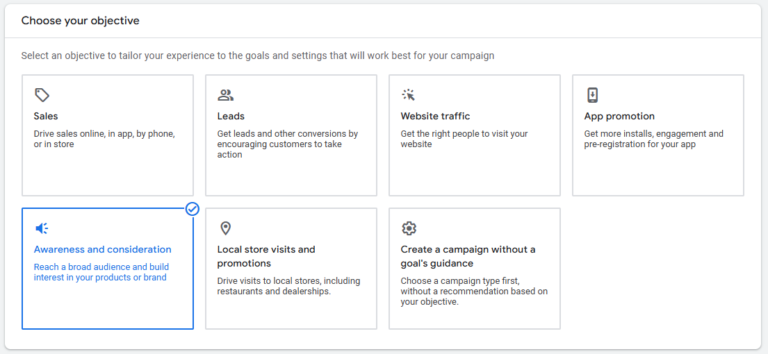
Awareness and Consideration Goals
This option helps increase brand visibility and engagement. It works well with campaign types like Search, Display, Video, Discovery, and Demand Gen, guiding Google’s algorithms to optimize for better awareness and initial interest.
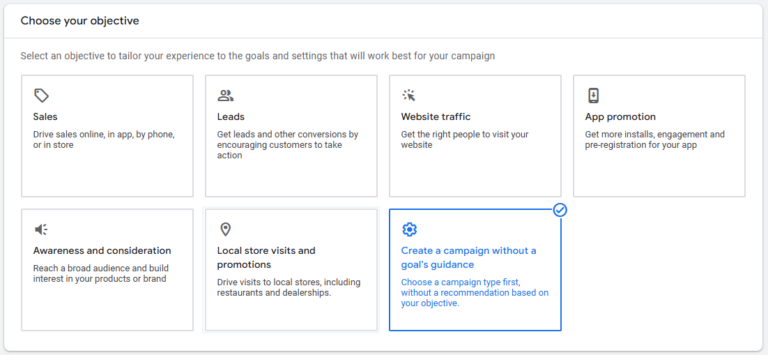
Proceed Without a Goal
This approach gives you greater flexibility by allowing full control over campaign settings, targeting, and bidding strategies. It’s a suitable choice for experienced marketers who prefer manual optimization rather than relying on Google’s automation.
Campaign Selection
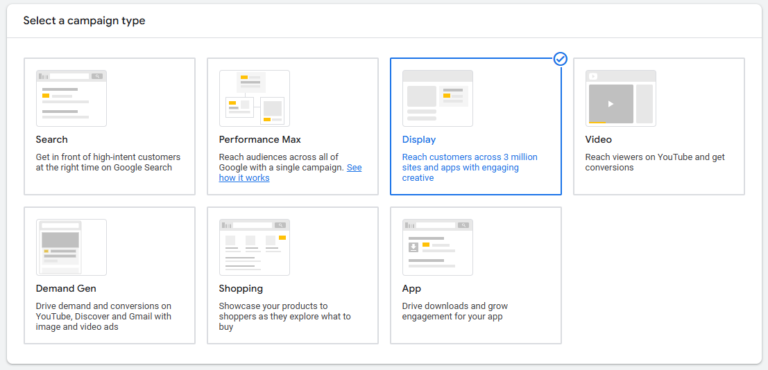
Selecting the right campaign type can be challenging, as this decision will shape your marketing future. If you’re unsure, consider opting for Display Ads. Despite being one of the older campaign types on Google, Display Ads offer unparalleled reach, allowing you to target customers across 3 million websites and apps.

While Performance Max has become popular, many marketers overlook Display Ads. However, Display remains a powerful option for driving brand awareness and reaching a broad audience. Choosing this campaign type can set you up for success in reaching potential customers at scale.
Conversion Goal Selection
Conversion goals are the backbone of any successful marketing strategy. They define what you aim to achieve through your campaigns, whether it’s increasing website traffic, generating leads, boosting online sales, or driving app downloads.
A well-defined conversion goal provides a clear direction, helping you align campaign settings, bidding strategies, and audience targeting to achieve meaningful results. Without a proper conversion goal, your marketing efforts may lack focus, leading to wasted budget and lower returns.
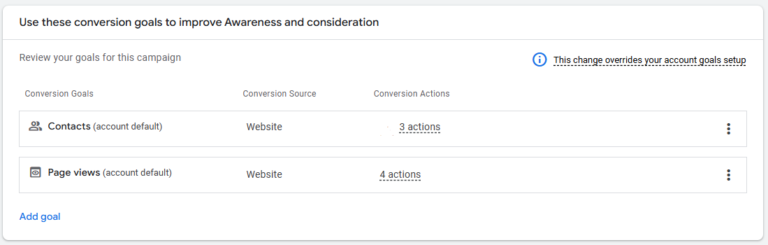
When planning a Top of Funnel (TOF) marketing strategy, selecting the right conversion actions is crucial. For this stage, focusing on Page Views, Product Views, and Product Clicks is highly effective. These actions help capture valuable engagement signals from a broad audience, which is essential for building awareness.
Since TOF marketing targets a wide and diverse audience, the initial objective is to attract as many potential customers as possible. These early interactions lay the foundation for data collection and audience segmentation.
Campaign Settings
At this stage, we won’t make many technical changes. The key action here is to enable Dynamic Display Ads. Since we’re targeting a broad audience, dynamic ads help show the most relevant content to potential customers based on their interests and past interactions on GDA.
This approach not only improves Click-Through Rates (CTR) but also drives quality website traffic from a more relevant audience.
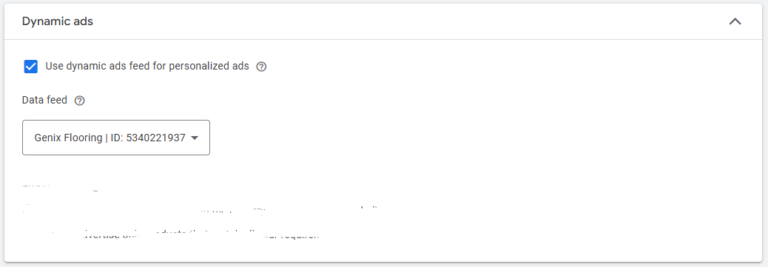
Marketing Technical Setting
Here, you have the flexibility to choose settings based on your specific marketing needs and objectives. However, it’s essential to keep the audience targeting broad at this stage. Running your campaign with a broader audience helps you gather valuable data that can be leveraged in the next phase for consideration and retargeting campaigns.
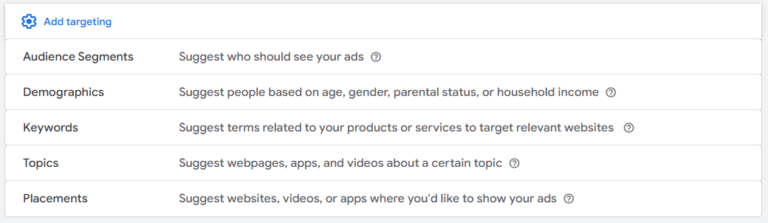
This approach ensures that your marketing strategy becomes more refined and data-driven, improving performance as you move down the funnel.
Persuasive Ads Copy
Persuasive ads play a crucial role in any marketing strategy. Display campaigns, in particular, offer dynamic opportunities to engage audiences by showcasing high-resolution images, up to five YouTube videos, five compelling headlines, one long headline, and five descriptions.
Ad Copy Checklist:
- Solution-oriented messaging
- Attention-grabbing headlines
- High-quality visuals
- Clear call-to-action (CTA)
For Top-of-Funnel (TOF) awareness marketing, it’s essential to craft solution-oriented ad copy that grabs user attention and keeps them engaged. Focus on addressing your audience’s pain points and highlighting the value your brand offers right from the start. This approach not only boosts engagement but also sets the foundation for a successful marketing journey.

Video Ads Strategy:
You can ABCDs that is an official YouTube principle that covers (Attention, Branding, Connection and Direction)
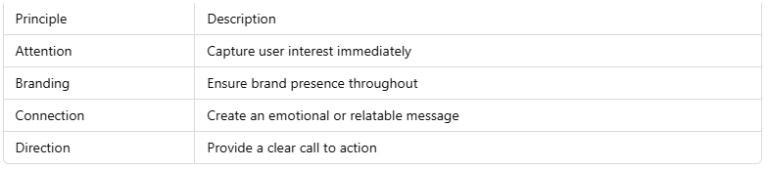
Image Recommendation
Google Display Ads appear on over 3 million websites, over 650,000 apps, and across Google properties such as Gmail and YouTube.

Recommendation
Campaign structure is one of the most technical and essential aspects of Google Ads. To achieve success, especially for large eCommerce stores, it’s crucial to draw a well-planned roadmap of your marketing strategy before execution.
- If you have an un-capped marketing budget, a granular account structure will provide better targeting and tracking opportunities. Segment campaigns based on product categories, audiences, or regions for more actionable insights.
- Awareness campaigns require time to deliver meaningful results. Allow them to run without frequent changes to create a lasting impact.
- Display marketing is an ideal choice for TOF campaigns, offering vast reach across millions of websites and apps.
- Select goals like Page Views, Product Views, and Clicks at this stage to capture early engagement metrics.
- Avoid narrowing your audience at the TOF stage. Instead, target a broad audience to gather valuable data for refining future campaigns.
- Connect your Google Merchant Center and upload a product feed to enhance targeting and campaign performance for eCommerce stores.